
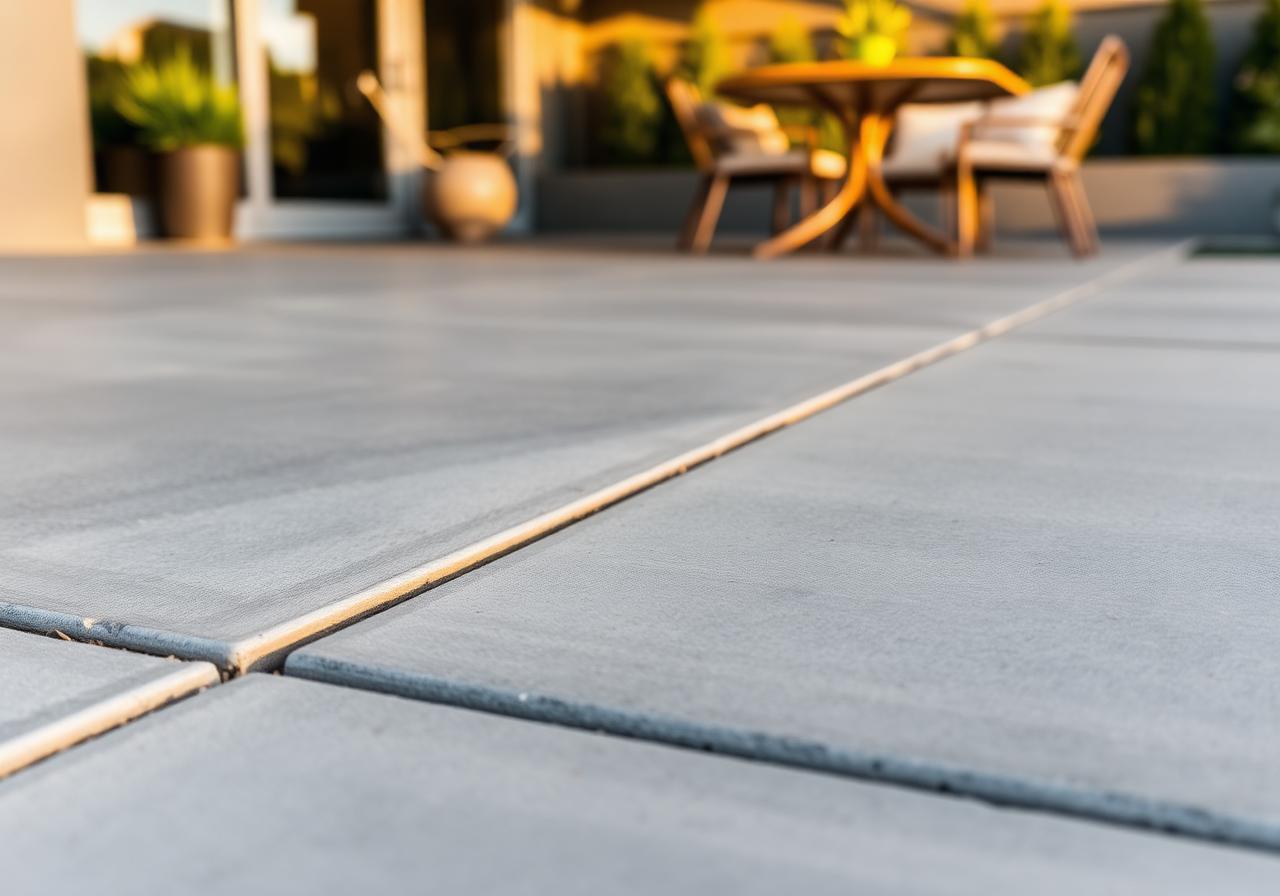
Concrete vs Pavers: Which Is Better for Your Prescott Home?
Both look great on day one. Here's what actually holds up in Prescott's freeze-thaw climate — and which one costs less over 20 years.
Poured concrete
A continuous slab of reinforced concrete, finished with broom, stamp, or decorative texture. The default choice for driveways and patios across Prescott and Yavapai County.
- Lower upfront cost per square foot
- 30–40 year lifespan when properly poured
- No weeds, no settling, no re-leveling
- Handles heavy vehicles (RVs, trucks) without special prep
- Stamped and colored options match paver aesthetic
- Cracks over time (though controlled with joints)
- Full replacement required if damaged severely
- Cannot be easily removed for underground repairs
Pavers (concrete or clay)
Individual precast concrete or clay pieces set on a compacted base with polymeric sand joints. Popular for high-end residential projects.
- Individual pavers can be lifted and replaced
- Wide variety of colors, shapes, and patterns
- No visible cracking — movement is absorbed at joints
- Access for underground utility repairs is easier
- Higher upfront cost (typically 30–50% more)
- Settling and heaving common in freeze-thaw climates without perfect base prep
- Weeds and moss in joints require ongoing maintenance
- Polymeric sand needs re-application every 3–5 years
Head-to-head comparison
| Attribute | Poured concrete | Pavers (concrete or clay) |
|---|---|---|
| Installed cost per sq ft | $8–$18 | $14–$28 |
| Lifespan | 30–40 years | 20–30 years |
| Annual maintenance | Minimal (sealer every 5–7 yr) | Weed removal, sand top-up every 3–5 yr |
| Crack behavior | Hairline cracks controlled by joints | Individual pavers may heave or settle |
| Heavy vehicle capacity | 6" reinforced pad handles RVs, trucks | Requires thicker base and reinforcement |
| Design flexibility | Stamped, colored, exposed aggregate | Endless patterns, shapes, colors |
| Repair access | Section removal + re-pour | Lift and replace individual pavers |
| Freeze-thaw performance | Excellent with air-entrained mix | Depends heavily on base prep quality |
The verdict
For most Prescott, Prescott Valley, and Chino Valley homeowners — poured concrete wins on cost, longevity, and maintenance in our climate. Pavers make sense when you want a specific design aesthetic that concrete can't replicate, or when you need easy access to underground utilities. If you like the paver look but want concrete's economics, stamped concrete gives you 90% of the visual for ~60% of the price.
Common questions
Which lasts longer, concrete or pavers?
Properly poured concrete typically lasts 30–40 years in Prescott. Pavers last 20–30 years but require ongoing joint maintenance.
Are pavers worth the extra cost?
In most cases, no — unless the design flexibility matters or you need access to underground utilities. Stamped concrete gives you the paver look at concrete pricing.
Do pavers really heave in cold climates?
Yes — inadequate base prep is the #1 cause of paver failure at Prescott's elevation. Well-built pavers with a 6-inch compacted base perform fine; cheaply installed ones don't.
Related decisions
Still deciding?
Our team will walk your property and give an honest recommendation — no upsell.
Get a free consultation